

 English
 عربى
عربى
Home / News / Industry News / Anti-Stuck Rotary Valves With Bayonet Type: Design, Selection & Maintenance
Industry News
Content
There is a particular moment every plant operator recognises: the drive keeps running, the chain keeps turning, the counter keeps counting, but the rotor has stopped moving material. Within minutes, powder starts backing up in the hopper above, the conveying line loses pressure, and someone is standing at the valve with a wrench in hand. On a baghouse discharge or a pneumatic conveying feed point, a stuck rotor can bring an entire production line to a halt.
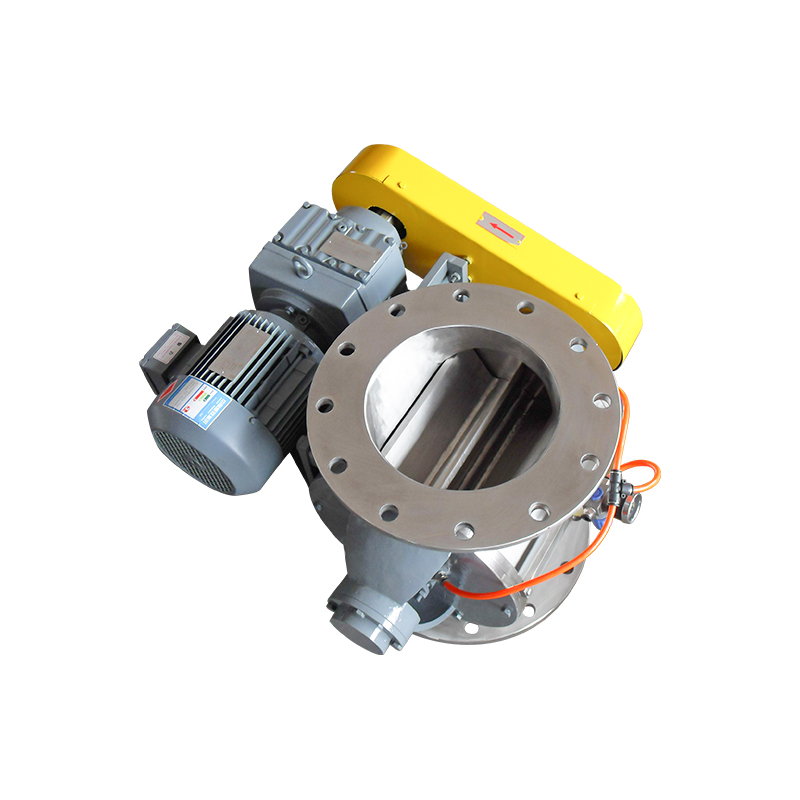
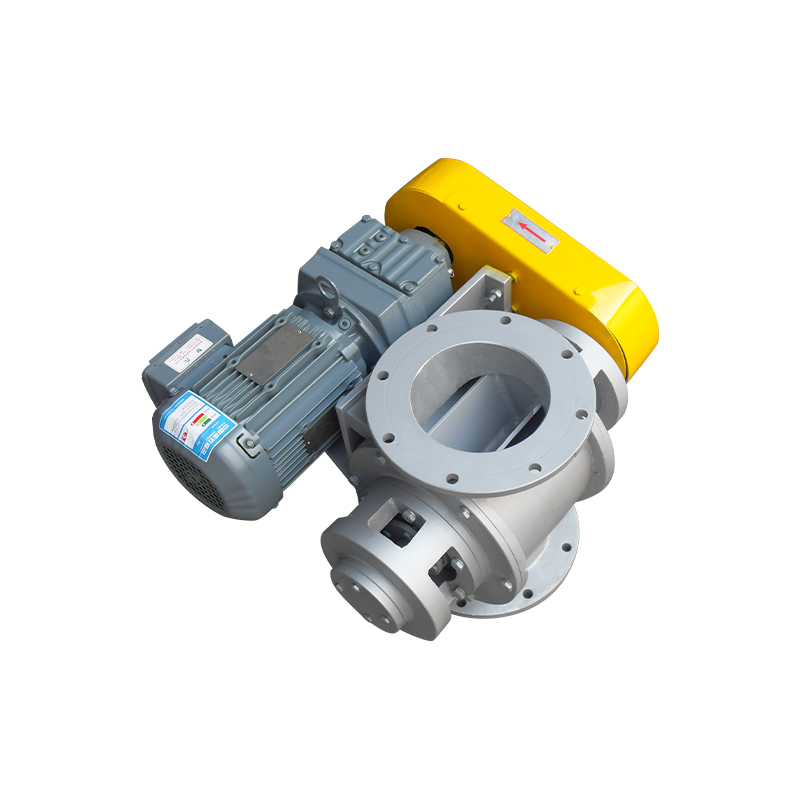
Anti-stuck rotary valves with bayonet type mounting are built for exactly that situation. They accept that jamming happens in real powder handling, and they are designed so that clearing a jam takes minutes rather than a full shift. We have been manufacturing rotary valves in Changzhou since 2008, and the bayonet-type model in our ZRB anti-jamming series has become one of the units plant teams ask for most often when sticky, fibrous or awkwardly shaped material is the real problem in their system.
Before choosing a valve, it helps to identify which of several very different problems you are actually trying to solve. "Stuck" describes a symptom, not a cause, and the fixes are not interchangeable.
The last point is worth repeating, because it saves a lot of unnecessary work. A rotor that will not turn is not always a rotor that is blocked. Check the drive first, then the valve.
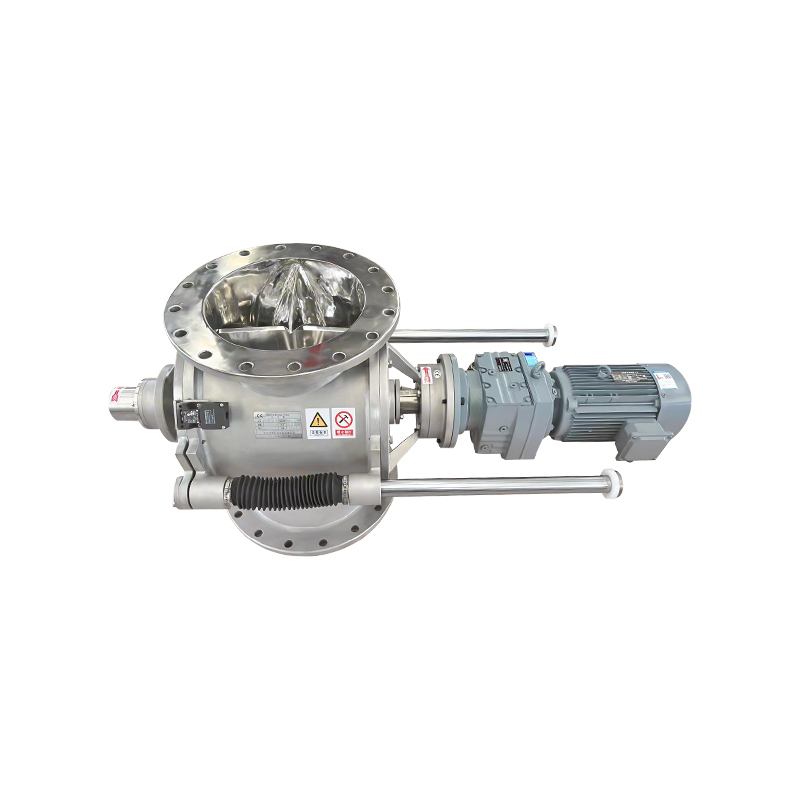
Bayonet type refers to the way the rotor assembly is mounted and released. Instead of an end plate held by a full circle of bolts, the rotor is carried on a twist-lock connection, so a short rotation releases the rotor and end plate together while the valve body stays bolted into the pipeline flange.
That single design decision changes the economics of a jam. The conventional recovery route is long: isolate the line, unbolt the valve, drop it out of the flange pair, carry it to the workshop, free the rotor, then reassemble and realign everything. Under a silo with limited headroom, that can easily consume half a shift. With a bayonet connection, a technician opens the access, twists and withdraws the rotor, clears the blocked pocket, and refits the assembly in place.
There is a second, quieter benefit. A rotor refitted by hand after an emergency repair often ends up a fraction off centre, and valves with disturbed clearances tend to jam again sooner. The bayonet seating arrangement returns the rotor to the same position each time, so the clearance set at the factory is the clearance you run with.
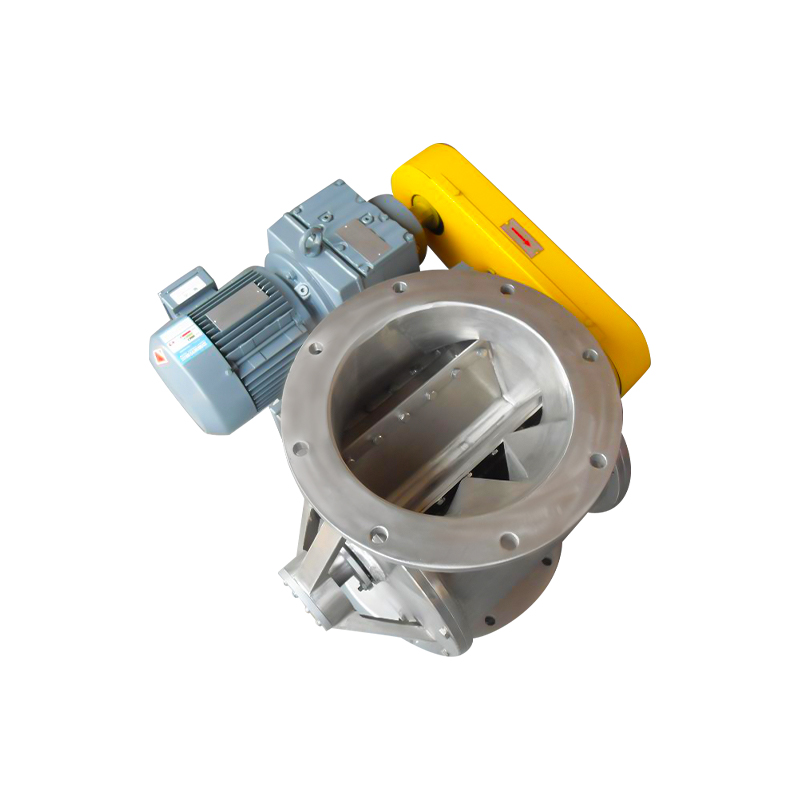
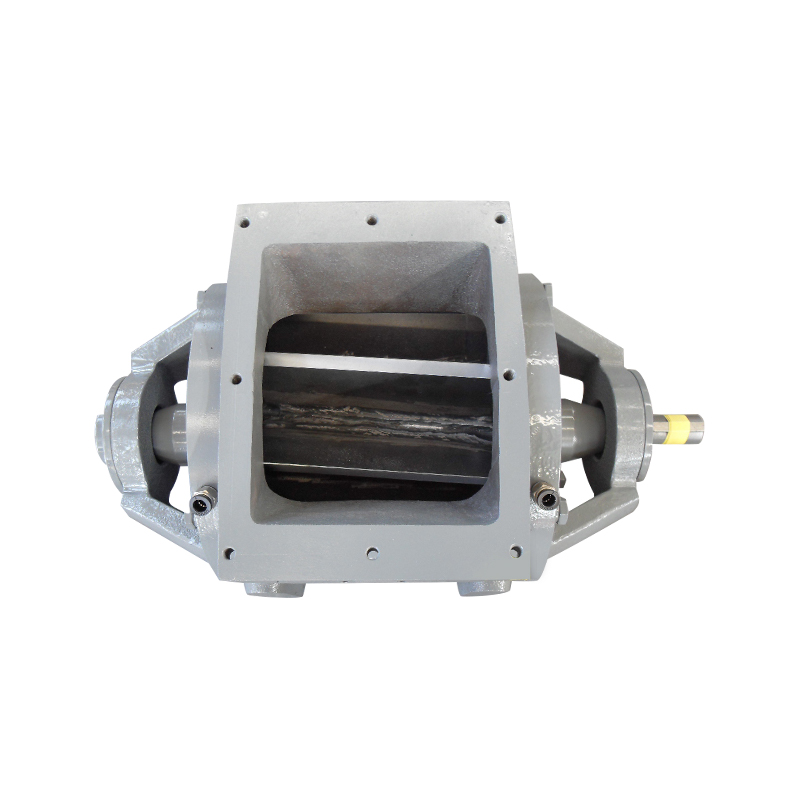 Anti-Stuck Rotary Valve With Bayonet Type1. Anti-adhesion and anti-stuck Destroy the adhesion layer: When the bayonet rotates, it continuously "plows open" the material layer (such as sludge, wet powder, past...View Product →
It is equally fair to say what the bayonet design is not. It is not a cure for a misapplied valve. If a unit is undersized for the throughput, running at the wrong rotor speed, or handling a material well outside its intended range, quick access simply means you will use it often. Quick access is a recovery tool, not a substitute for correct selection.
The ZRB series covers three different structural answers to the same broad problem. They are not competing versions of one idea; each one attacks a different mechanism of blockage.
| Design | How it reduces sticking | Duty it suits best |
|---|---|---|
| Bayonet type | Rotor and end plate release with a short twist, so a jam can be cleared and the rotor withdrawn without unbolting the body from the line | Sticky or agglomerating powders, frequent cleaning, short maintenance windows |
| Offset inlet and outlet | Inlet and outlet are set off the vertical centre line so material does not fall directly onto the rotor tip | Free-falling granular feeds, abrasive material, high-impact drop points |
| V-rotor | V-shaped pockets change how material is carried and released, reducing wedging across the pocket | Irregular particles, flakes, fibrous or easily interlocked material |
If the jam always occurs where material enters the valve, and the feed arrives with some velocity from a chute or a rotary feeder above, the impact itself is doing the damage. Offsetting the inlet and outlet keeps the falling stream away from the rotor tip and spreads wear more evenly across the pocket. This is the variant we recommend most often for abrasive mineral and granular duty.
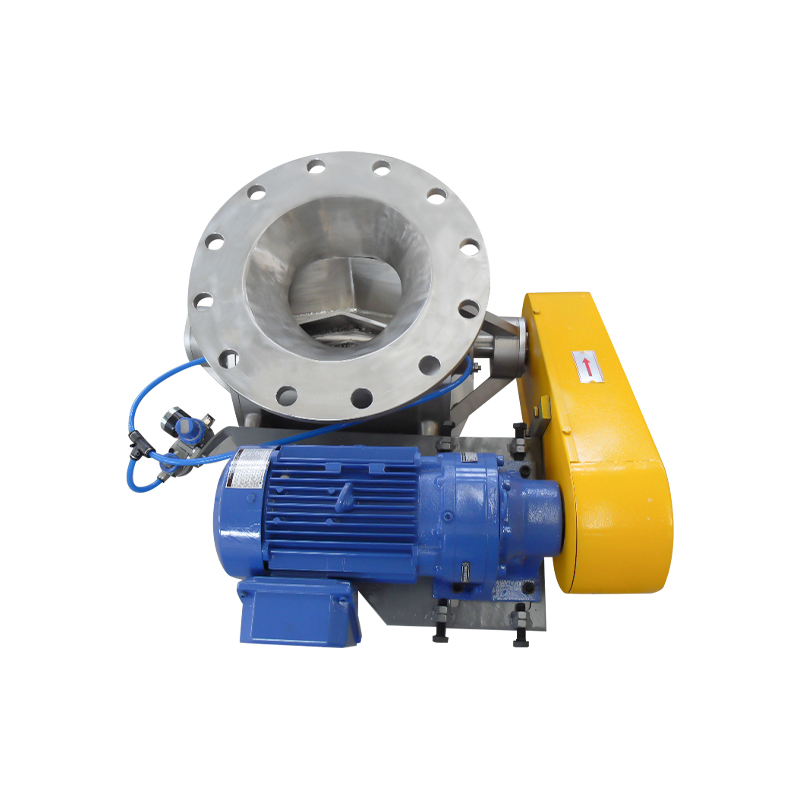
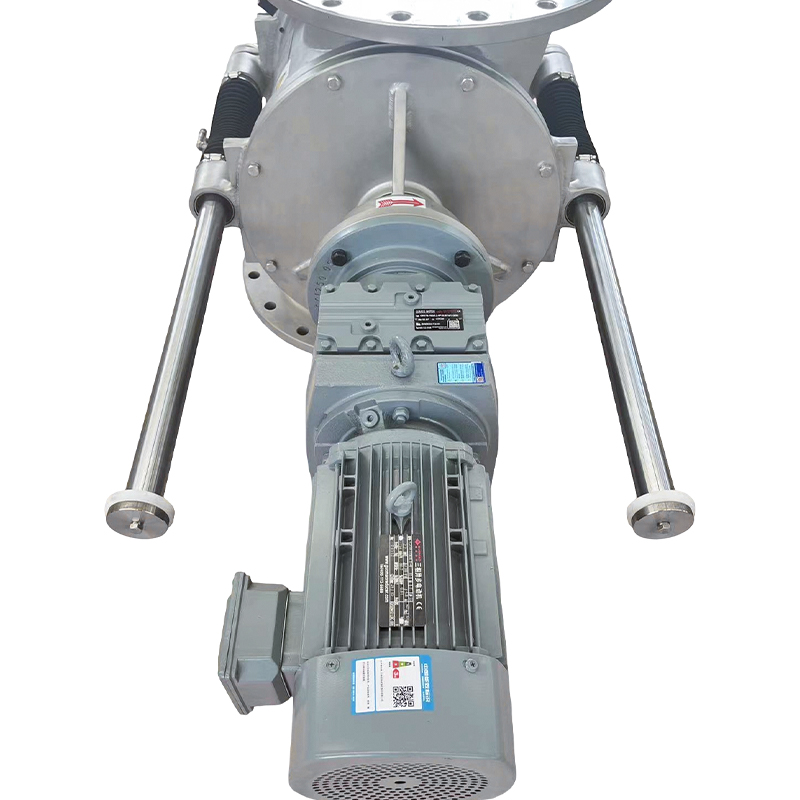 Anti-Stuck Rotary Valve With Offset Inlet And Outlet1. Inlet/outlet centerline offsetView Product →
Flakes, fibrous residues and particles with a tendency to interlock can pack into a conventional pocket and ride around with the rotor instead of discharging. A V-shaped pocket alters the geometry of that carry, so material releases earlier and with less binding. Where the blockage is a material-shape problem rather than an impact problem, this is usually the better starting point.
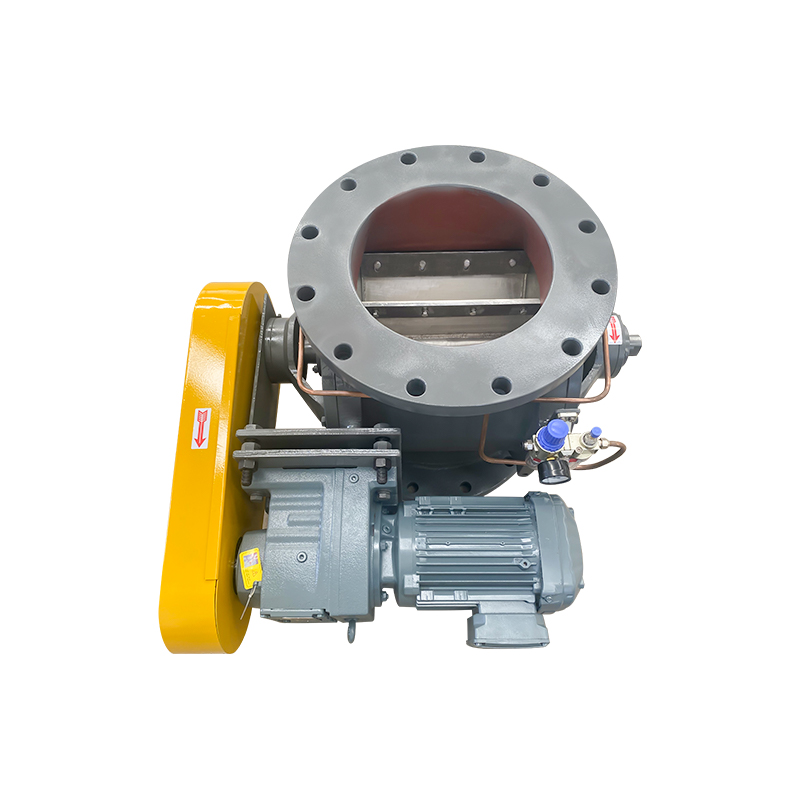
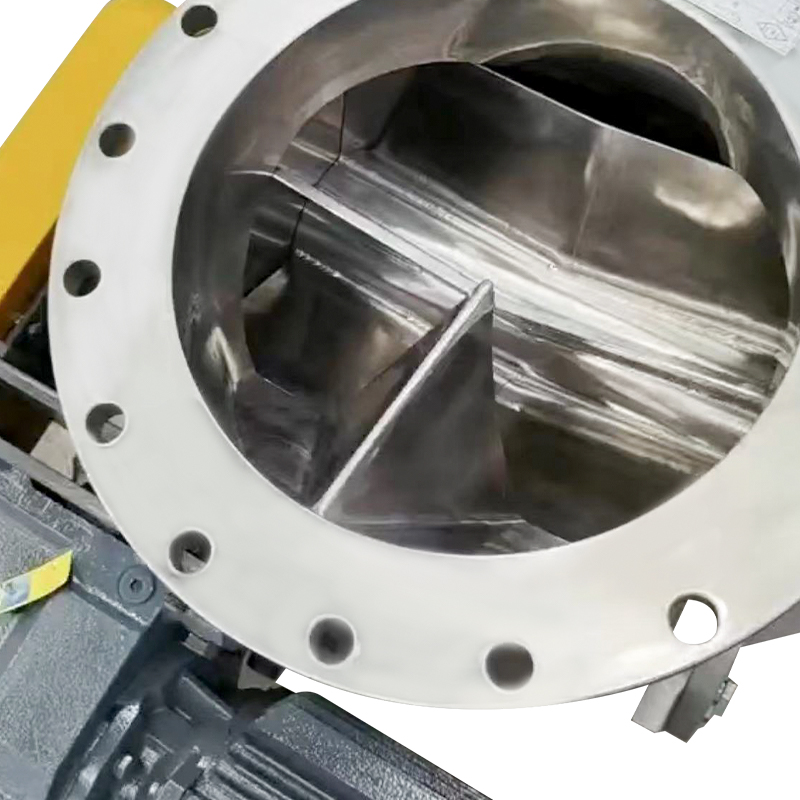 V-Rotor Anti-Stuck Rotary ValveV-rotor anti-stuck rotary valve is a high-performance rotary feeding equipment optimized for reducing the risk of jamming and improving passability. It is suitable for...View Product →
In real plants, the three designs frequently coexist. A bayonet-type valve may sit under a dust collector where cleaning access matters most, while an offset unit handles a coarse feed upstream. Selection should follow the specific blockage mechanism at each point of the system, not a single house standard applied everywhere.
Before requesting a quotation, gather the following information. The more of it you can supply, the more precisely the valve can be matched, and the less likely it is that anti-stuck features end up compensating for a selection error.
Weekly, inspect for unusual noise or vibration and check for material weeping past the end plate. Monthly, verify chain tension and coupling condition, and confirm the rotor turns freely by hand with the drive isolated. At each scheduled shutdown, open the valve, inspect the rotor tips and housing bore for scoring, and confirm that the pockets are clean and undamaged. On a bayonet-type unit, this last step takes a few minutes, which is precisely the point of the design.
Our rotary valves serve petrochemical, power generation, environmental protection, food processing, pharmaceutical, metallurgy and building material applications, handling solid particles, powders and ultrafine materials in both positive and negative pressure systems. Dust collection hoppers, fly ash discharge points, catalyst and additive feeding, mineral powder transfer and food ingredient handling all present their own version of the sticking problem, and the anti-stuck range was developed around those everyday difficulties rather than around ideal laboratory materials.
If you would like a closer look at the wider range, our ZRB series anti-jamming rotary valves page sets out the three structural options side by side. For a broader explanation of the mechanisms involved, we also keep a practical article on how anti-jamming rotary valves prevent material blockage in dust collection lines.
Changzhou Jinkui Machinery Manufacturing Co., Ltd. was established in 2008 and operates from a 6,000 square metre factory in Jiangsu, supplying rotary valves and related dust collection components to customers in more than 20 countries. Our product programme covers eight series and over fifty models, from round-port and square-port discharge valves to quick-cleaning and positive pressure conveying types, and we build customised units for high temperature, large size and high wear duty. If a standard model does not fit your material, tell us what the material actually does inside the valve, and we will work from there.
A jammed rotary valve is rarely a mystery once the mechanism is understood. Decide whether your problem is impact, stickiness, material shape or access, match the structure to that answer, and keep the clearances as they were built. That approach has kept powder lines moving for our customers for more than fifteen years, and it will keep yours moving too.